Profi · AI tutor matching, service marketplace
Company
Profi is a large service marketplace: tutors, repair, beauty, home services. A client describes a task, specialists reply with offers, and the client picks who to work with.
Tutoring is one of its biggest verticals. That’s where I worked, in the growth team.
Role
Senior Product Designer in the tutoring vertical. I owned the AI matching experience end to end on web, mobile web, and iOS, together with a product manager, analysts and engineers.
The work went from interviews and usability tests to A/B tests on the internal experiment platform, and prototypes I built in code with Claude and Claude Code.
Results
Client-to-contact
conversion, final design
Iterations, each A/B
tested vs original
In-depth
interviews
A/B tests
in 6 months
Case study
Teaching an LLM to pick a tutor, and earning the client’s trust in that pick
A client posts a request and gets a stream of offers, often more than they can read. Many read a few and never write to anyone. The gap between interest in a specialist and the first message was the biggest drop in the funnel.
The idea was to let the product do the first round of choosing: show the best few offers for this task, say why each one fits, and let the client ask for others in plain words. It took four stages to get there. Before the first one, we went and listened.
01
Synthetic respondents
Weak hypotheses died in a chat window, not in a two-week A/B test.
Before the first iteration we ran 9 in-depth interviews with parents and students who had looked for a tutor on Profi, and turned two of them into synthetic respondents: AI personas on Claude, each with a system prompt built from interview quotes, habits and contradictions.
There were always more hypotheses than A/B slots. The personas let us cut weak ideas in a chat window before they took a test, in three modes: interview, prototype test and hypothesis check. I later packaged the approach as a reusable Claude skill.
- ResearchInterviews9 in-depth interviews
- AI personaPersona promptQuotes, habits and deal-breakers turned into a system prompt
- AI sessionSession modeInterview, prototype test or hypothesis check
- LLMClaudeAnswers in the persona’s voice and pushes back
- TeamDecisionCut, change or send to A/B
Built with AI end to end: three of five steps run on Claude
Try it: pick a question or type your own. Replies marked “From the interview” are real quotes, translated; the rest paraphrase the personas’ prompts. The real tool runs live on Claude.
02
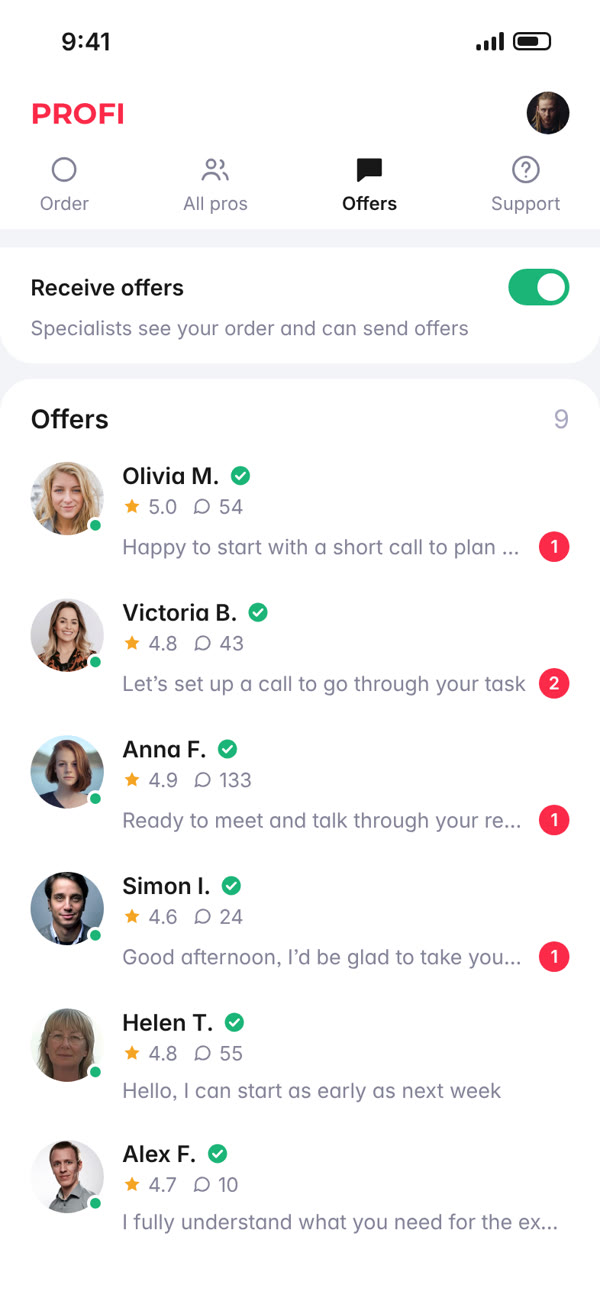
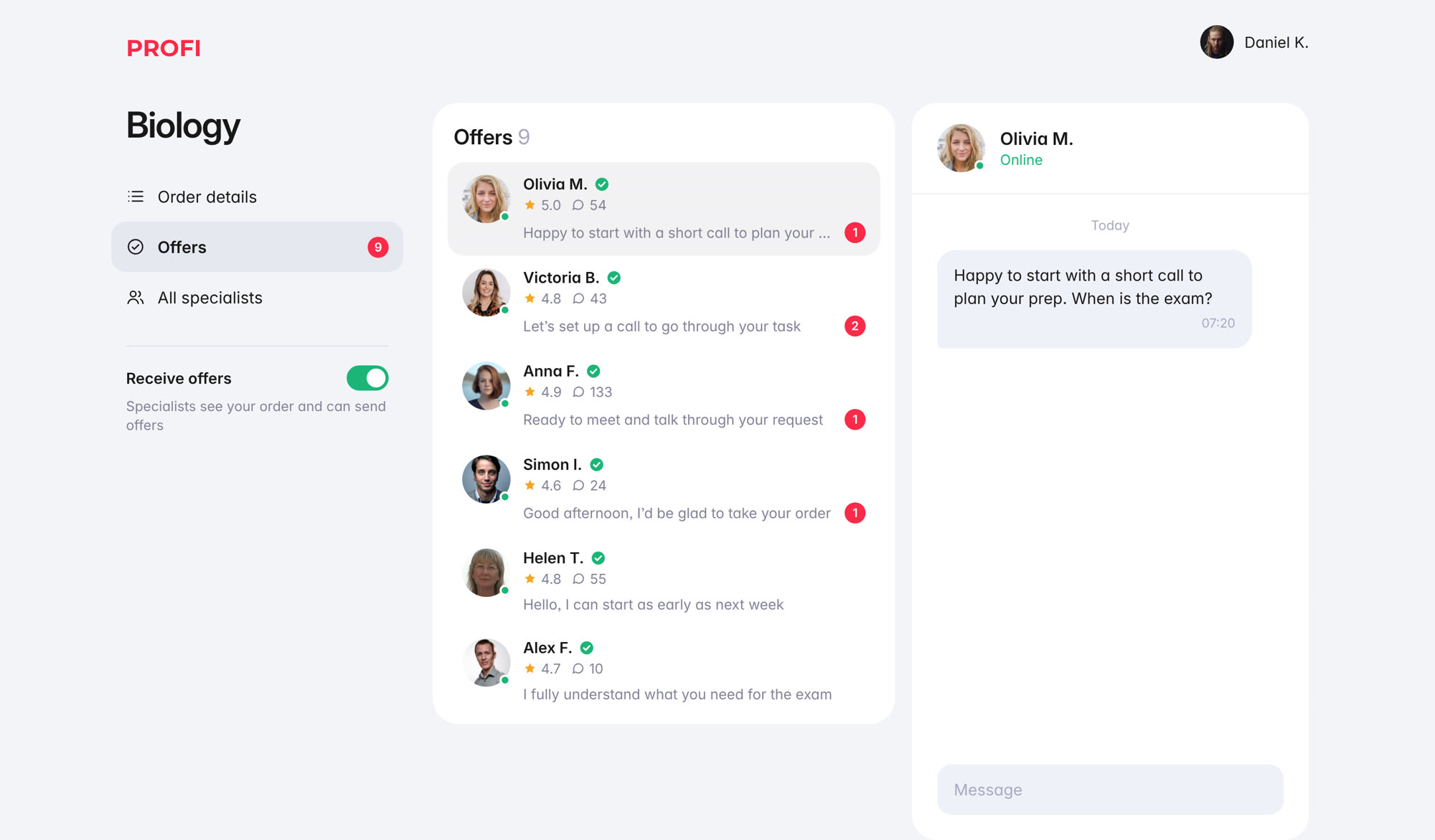
Variant A: the original list
Every offer in arrival order. No ranking, no reasons
A client posts a request and offers arrive one by one, in the order specialists replied. Nothing is ranked, nothing explains why one tutor fits better than another, and with a dozen offers people read a few and stop.
On desktop the offers sit in a column next to the open chat. On mobile web they fill the Offers tab as a long list. This is variant A: every iteration below ran as variant B in an A/B test against it.
Tap a screen to enlarge
03
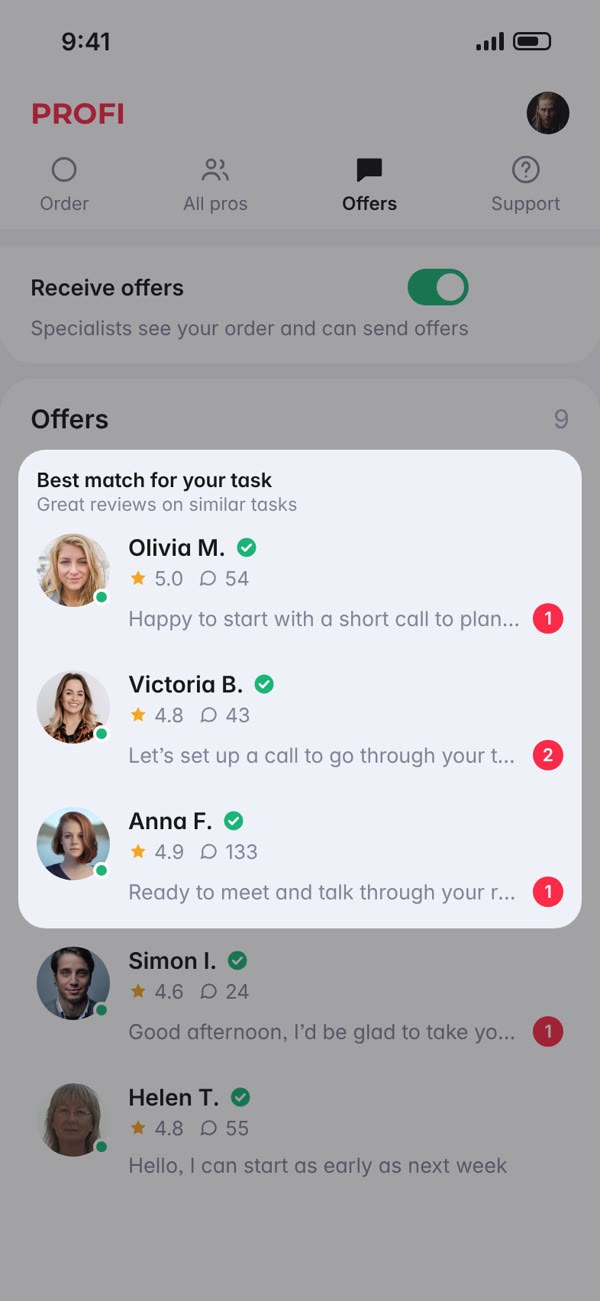
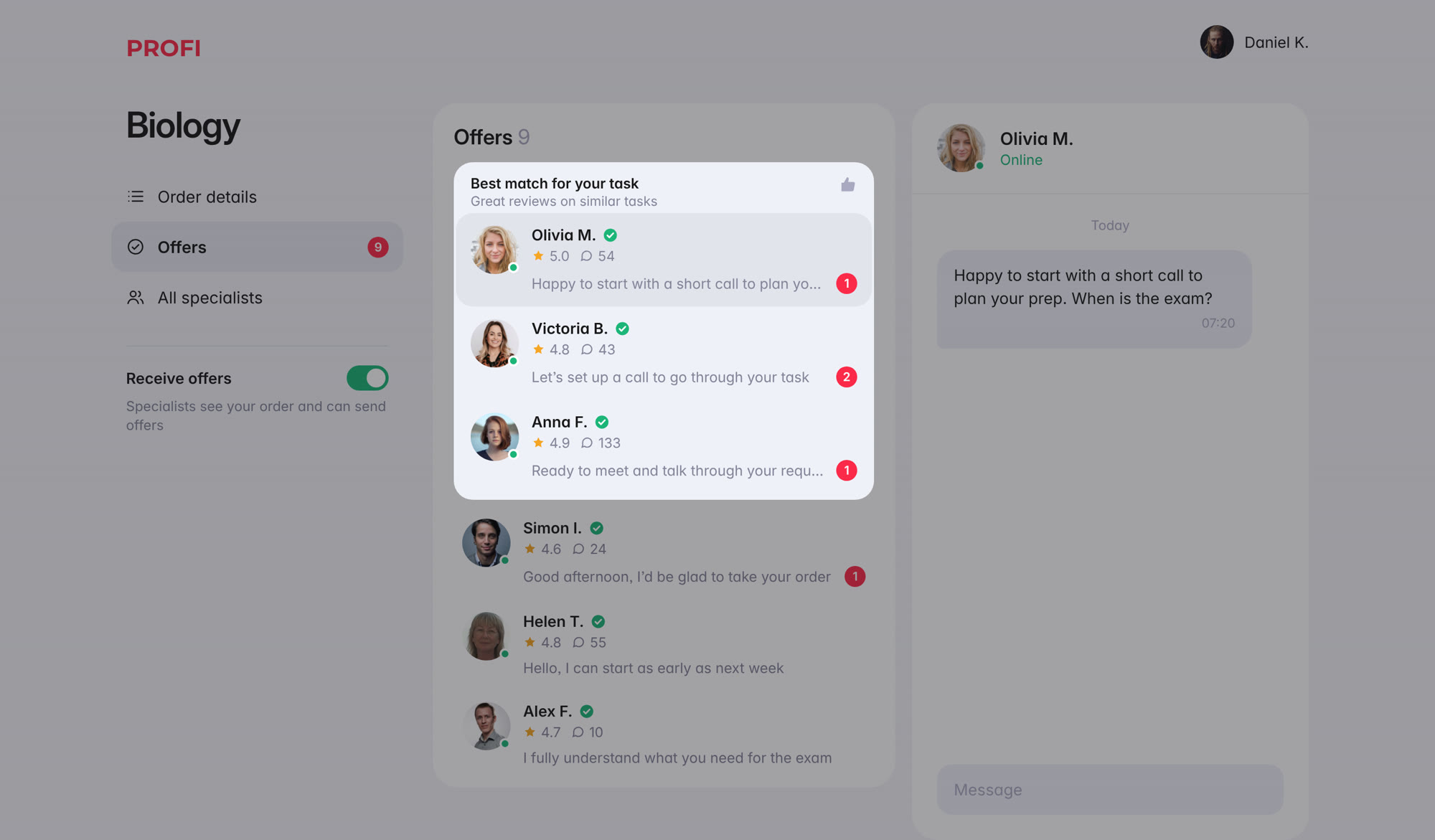
Iteration I: a shortlist of three above the offers
A block of three best-reviewed offers on top of the list
When a request collects eight or more offers, the list opens with a block of three that have the best reviews on similar tasks. Below eight there is no block: a shortlist of three out of five is noise. The rest of the list stays as it was, and pinned chats stay pinned.
On desktop the block sits at the top of the offers column. On mobile web it takes the first screen under the Offers tab, so the client sees the three before scrolling. Client-to-contact conversion grew by 21%: clients want the product to do the first round of choosing.
Tap a screen to enlarge
04
Iteration II: reasons from reviews and a form to ask for others
“Praised for” tags from reviews and a form to find other pros
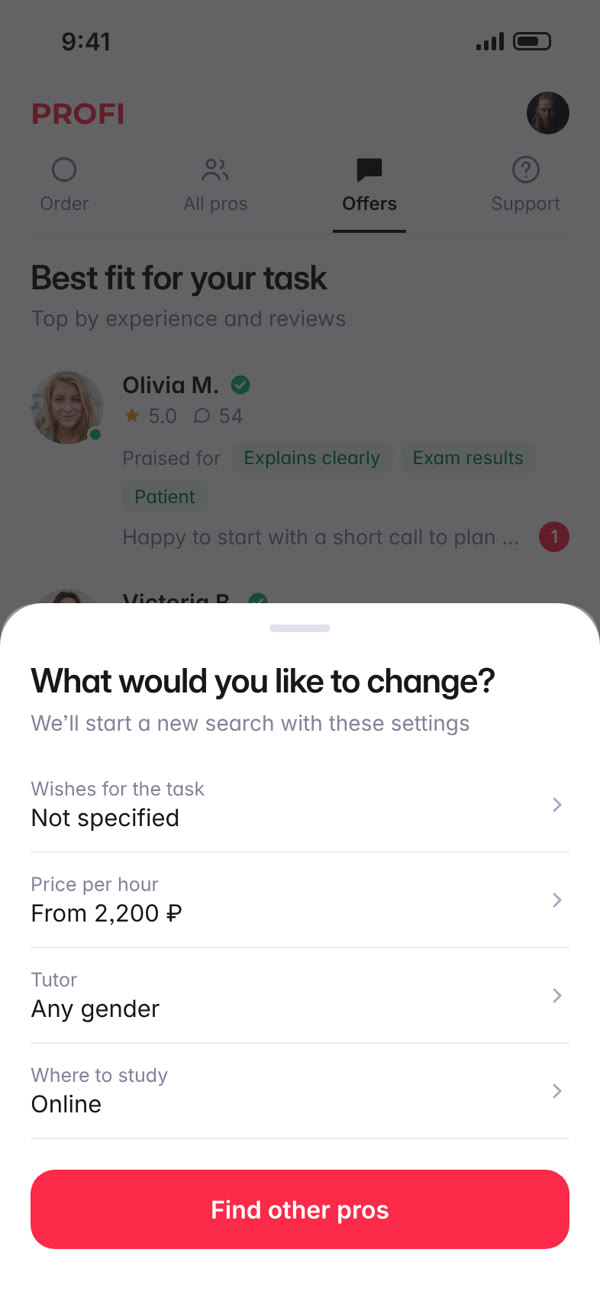
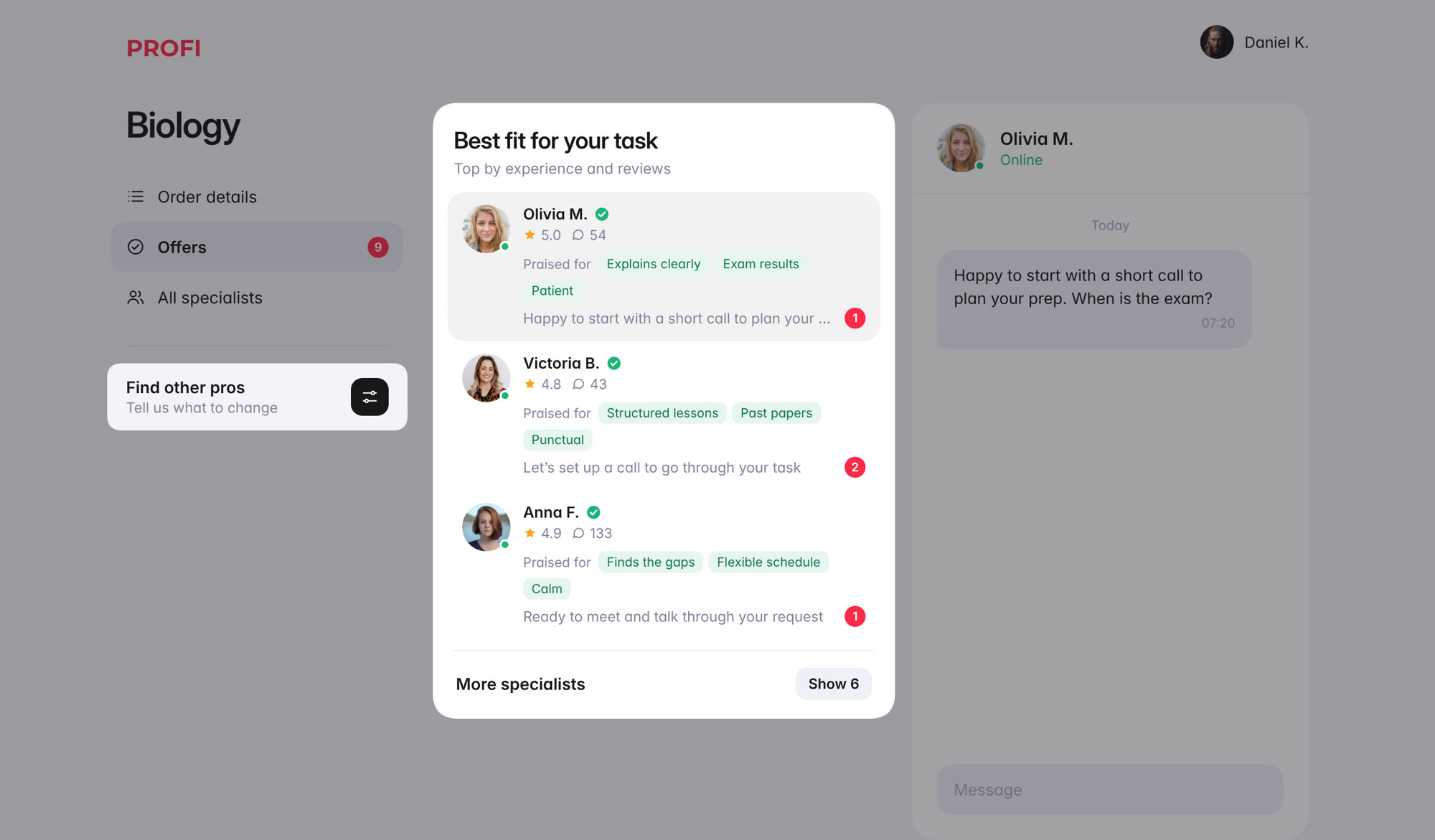
The shortlist got a reason. Under each tutor we show what clients praise them for, taken from reviews, and the block got a name the client understands: best fit for your task. The rest of the offers fold under “More specialists”.
If none of the three fit, “Find other pros” opens a short form: wishes, price, tutor, where to study. On mobile web it is a bottom sheet over the list. Submitting starts a new search and moves the old offers down. Conversion grew by 13%: the reasons helped, but the fixed form only caught what we had thought to ask.
Tap a screen to enlarge
05
Iteration III: an LLM picks the three and explains why
An LLM picks three and writes “Why they fit you”
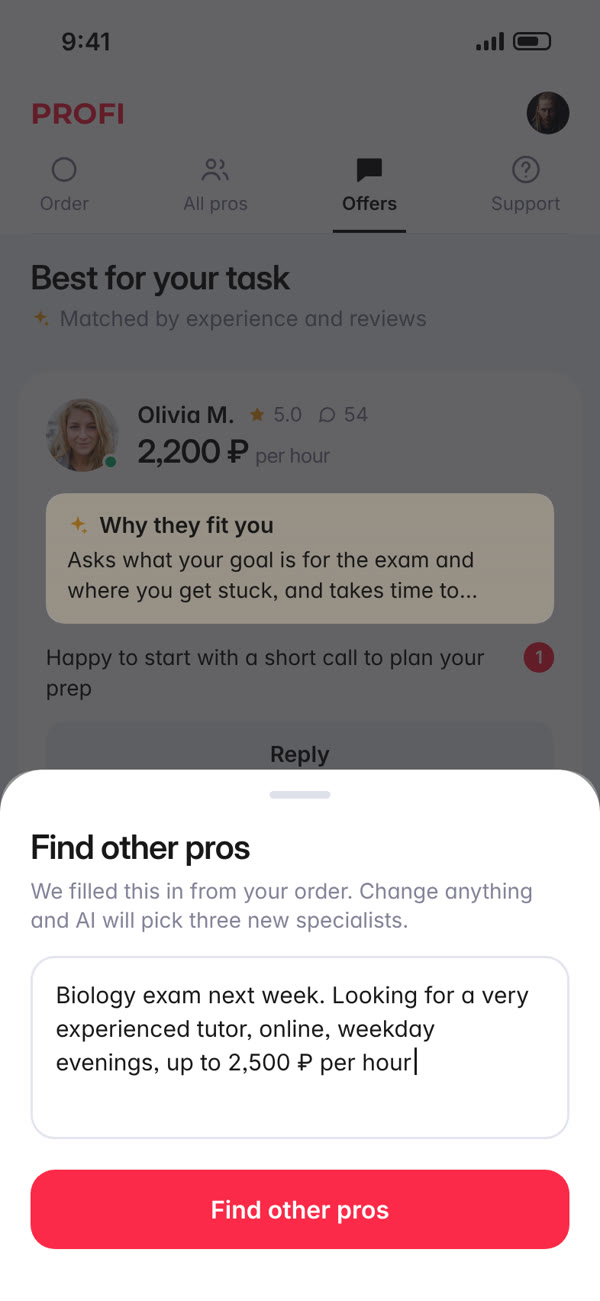
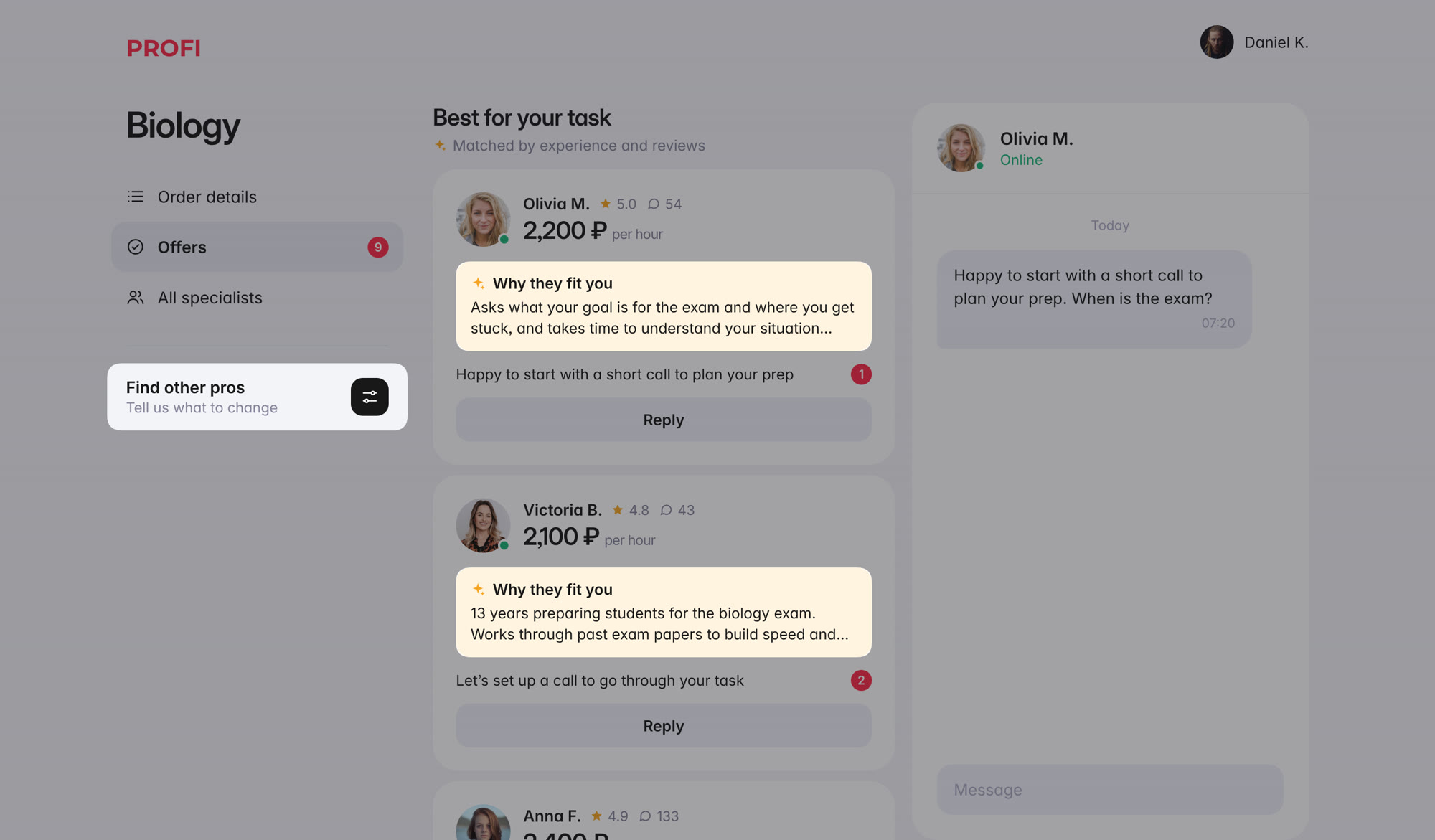
An LLM took over the pick. It reads the task the client wrote in the order wizard, ranks the offers against it and writes a short “Why they fit you” for each of the three. Picks appear one by one while it reads reviews, with no skeletons.
“Find other pros” turned into a prompt prefilled from the order: the client edits a sentence and the LLM picks again. On mobile web the prompt opens as a bottom sheet with the keyboard up, like writing a message. Conversion grew by 18%. Usability sessions showed why not more: explanations read as generic AI text, and the other offers felt hidden.
Tap a screen to enlarge
06
Iteration IV: the same LLM, grounded in the client’s criteria and reviews
Explanations built from the client’s criteria and a sourced review fact
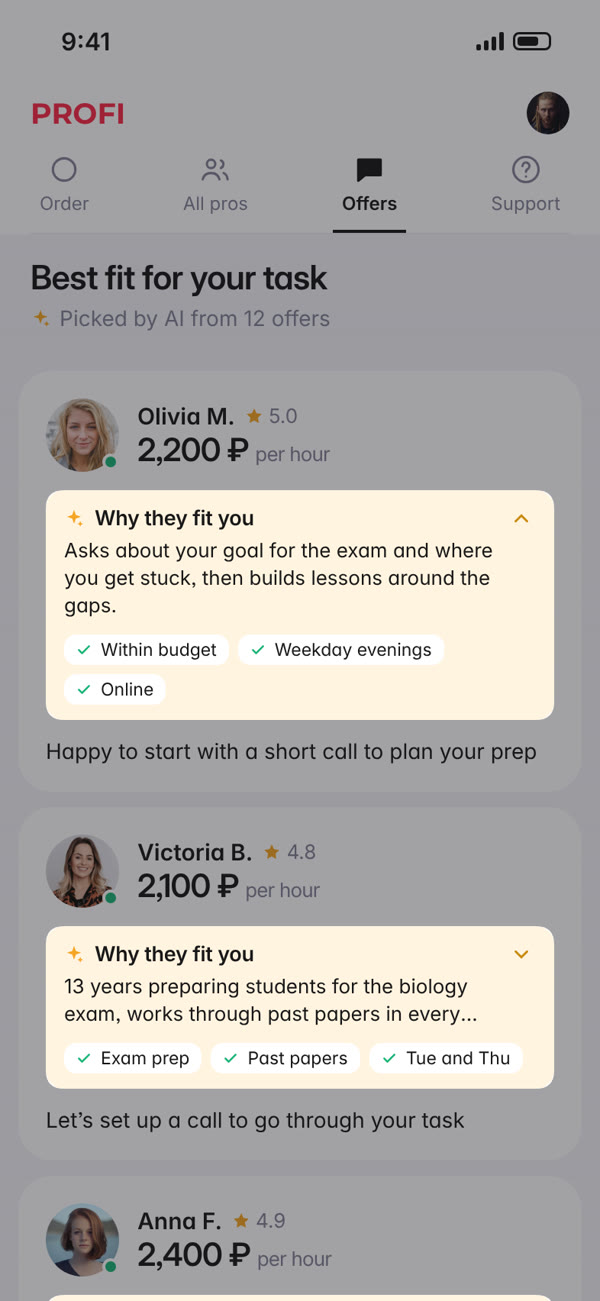
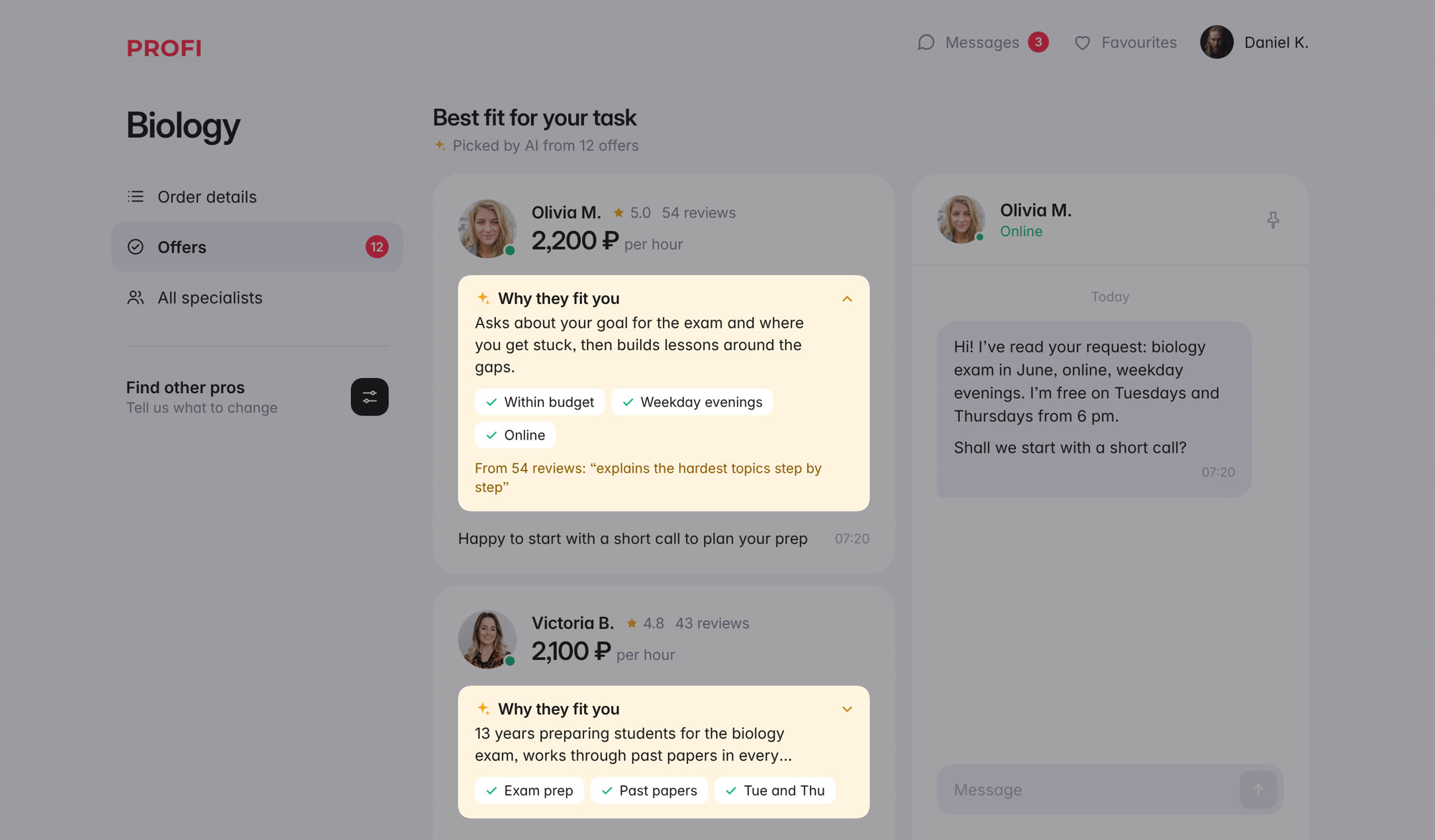
We kept the model and rebuilt the frame. Each explanation now starts from the client’s own criteria, budget, time, format, shown as tags, and ends with one fact from reviews with its source. Two picks of the same task can no longer sound the same.
The shortlist became a highlight on top of the full list, so nothing is hidden. Re-picking got hint chips next to the prefilled prompt, and the loader says what the AI is doing. On mobile web the tags fit inside the card without opening it. Conversion grew by 23.5%, the best result of the four.
Tap a screen to enlarge
07
Outcome
Same model, better frame: +18% became +23.5%
Four iterations, each tested against the same original. The LLM in iteration III and iteration IV was the same model; the difference between +18% and +23.5% is design: what the explanation is built from, what stays visible and how the client asks for another pick.
By the end AI did four jobs in the product: it reads the task, ranks the offers, explains each pick with the client’s criteria and a sourced fact, and turns the order into an editable prompt. And two jobs in the process: synthetic respondents on Claude to cut weak ideas before an A/B slot, and prototypes built in code with Claude and Claude Code.
The final design: the client opens an explanation and writes to the first tutor
Four iterations, one original: how conversion moved
Each iteration ran against the same original list, so the bars compare like with like. The shortlist alone lifted conversion by 21%. Reasons from reviews and a fixed form gave less, 13%, and showed that people want to say what they need in their own words. The LLM pick brought it back to 18%. The same LLM, grounded in the client’s criteria and a sourced review fact, reached 23.5%.
| Iteration | Lift |
|---|---|
| I | +21% |
| II | +13% |
| III | +18% |
| IV | +23.5% |